
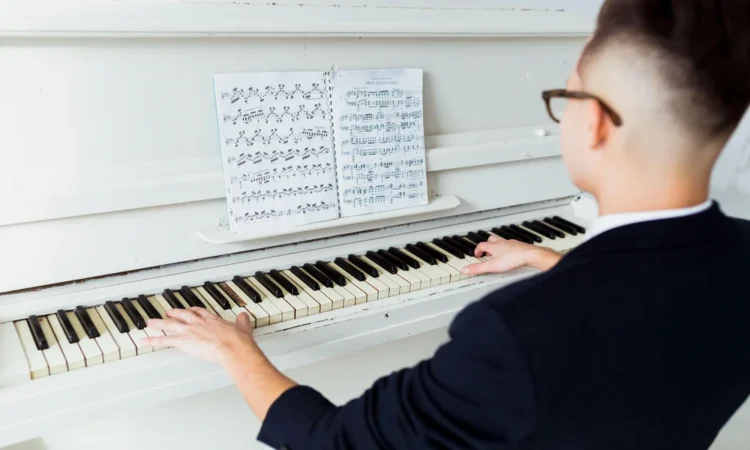
An adult who reads contracts, follows spreadsheets, and picks up unfamiliar software in an afternoon sits down at a piano and finds they cannot identify a note without counting up from middle C. It is a disorienting experience, and it leads a lot of capable people to conclude they lack some musical aptitude everyone else was born with. That conclusion is almost always wrong. Learning how to read piano sheets involves a specific set of obstacles that appear in a predictable order, and each has a known fix. Identifying which one you are stuck on is considerably more useful than practising harder at everything.
1. Counting Up From a Reference Note Instead of Recognising Directly
Nearly every beginner starts by locating middle C and counting upward or downward to identify a note. The method works and becomes the ceiling on reading speed, because counting takes time that a moving piece does not allow.
The fix is building direct recognition of landmark notes, so a handful of positions on each stave are known instantly and neighbouring notes are read in relation to them. Short, frequent recognition drills work considerably better here than long practice sessions, since the skill is recall speed rather than understanding.
2. Reading Two Staves at Once
Treble and bass clefs place notes differently, and beginners commonly read one fluently while translating the other more slowly. The result is hands that drift apart, with the weaker-reading hand lagging behind.
Practising each hand’s part separately until reading feels comfortable, then combining slowly, resolves this faster than repeatedly attempting both hands at tempo and hoping coordination arrives on its own.
3. Relying on Memory Rather Than Actually Reading
This one is particularly common among adults, because adults memorise well. A piece gets learned, the eyes stop tracking the page, and reading ability stops developing even as repertoire grows.
The remedy is deliberately reading new material regularly, at a level well below what you are currently learning. Many people taking piano lessons for adults in Singapore make faster reading progress once a teacher introduces a few minutes of unfamiliar easy material each session, precisely because it forces the eyes to work rather than the memory. It feels less impressive than polishing a harder piece, and it is where reading fluency is actually built.
4. Losing the Rhythm While Concentrating on Pitch
Beginners often focus so hard on which note comes next that timing collapses entirely. The notes are right, the rhythm is not, and the piece stops resembling music.
Separating the two helps: clapping or counting the rhythm before playing a passage, then adding pitch once the timing is secure. A metronome at a slow tempo builds the habit of holding time while reading rather than letting tempo follow whatever the hands can manage.
5. Practising Too Slowly to Develop Fluency
This sounds contradictory, since slow practice is generally sound advice. The issue is that reading fluency requires the eyes to move ahead of the hands, and at very slow tempos there is no pressure to look ahead at all.
Alternating careful slow work on difficult passages with faster reading of much easier material develops both accuracy and fluency, where practising only one produces one without the other.
Building a Routine That Treats Reading as Its Own Skill
Reading improves when it is practised deliberately rather than treated as a by-product of learning pieces. Affordable piano lessons can help learners build this skill through structured guidance and regular feedback. A workable routine gives a few minutes to note recognition, a few minutes to sight-read something genuinely easy and unfamiliar, and the remainder to repertoire.
Adults frequently resist the easy sight-reading portion because it feels like a step backwards, and it is usually the part that produces the fastest improvement. Progress here is measured in weeks rather than days, and the learners who improve most are generally the ones who kept that portion in the routine even when it felt unrewarding.
Contact Huckleberry Music School to discuss a practice approach that develops your reading alongside the pieces you want to play.
About Author